

As B2B marketing complexity increases, the days of isolated funnel stage optimization are over. Holistic “full-funnel” frameworks that guide buyers across integrated touchpoints now drive superior results. This whitepaper spotlights research-backed best practices for implementing effective full-funnel strategies.
Introducing the B2B funnel
The complexity of B2B marketing is increasing and specialized marketers are proving indispensable. New marketing disciplines are emerging, some marketers are being completely replaced by AI, and hip marketing theories such as “growth hacking” and “demand generation” are following in rapid succession. With increasing competition and AI-generated content creation on a massive scale, it is becoming increasingly difficult to stand out. Hyperpersonalization is seen as the key to success as seen in the growing popularity of account-based marketing strategies.
Marketing funnel models are also popping up like mushrooms, often with a similar setup but new terminology. The AIDA model (Awareness, Interest, Desire, Action) remains the most common model visualizing a linear buyer’s journey from initial brand contact to purchase. A variation on AIDA is the AIDAL model where “loyalty” is added as a fifth stage, referring to the phase that follows the purchase in which a customer is converted into a loyal customer, or, in hipper terms, “brand ambassador.
Other well-known funnels are The RECN Model (Reach, Engage, Convert, Nurture) and the See, Think, Do, Care Model. While these funnels provide tools for simplified visualization of a buyer’s journey, it is important to keep in mind that these simplifications are vastly removed from reality, especially when it comes to high-ticket B2B journeys.
By simplifying the buyer’s journey into a 4-layer or 5-layer funnel, it becomes easier to formulate a holistic strategy and justify certain investments. Thanks to these funnel models, it is possible to justify an investment in “awareness. In doing so, it provides tools for allocating marketing budgets and for identifying obstacles in a strategy, such as by determining that there is sufficient engagement but insufficient conversion. Such a funnel model can be quite meaningful as a starting point for formulating a strategy or for presenting a strategy intelligibly to management, but a B2B marketer should be aware that a good holistic strategy goes several layers deeper.

Marketing budget allocation by B2B organizations
One of the biggest challenges for B2B (marketing) managers is strategically allocating available budgets, especially in SMEs or SMB+ where budgets are limited. Important trade-offs in this context include short-term versus long-term goals, in-house versus outsourcing, and investing in new customers versus existing customers. The short answer: in all these cases, don’t choose either extreme but look for the right balance.
Business services companies on average spend 68% of the budget in attracting new customers and 32% in retaining and growing existing customers (LinkedIn Benchmark report 2023) but that doesn’t mean you have to do the same. This is an average and not a guideline. Ask yourself the following questions to determine what balance is appropriate within your organization:
- What is the average cost of bringing in a new customer versus retaining an existing customer?
- What is the potential lifetime value relative to the initial contract value?
- How large is the audience you can draw from?
- What are the additional benefits of a loyal customer? For example, the reference of new customers.
- How do you want to be known as an organization? How much are you willing to invest in the image of a loyal long-term partner?
Research shows that organizations are increasingly confident in the marketing team’s ability to grow revenue. In this, CFOs are even more optimistic at 60% than CMOs at 49% (LinkedIn Benchmark report 2023). On the one hand, this confidence makes marketers have more room and budget from management. But a danger also lurks here. In fact, this reduces marketing to a few financial metrics, often with a short-term focus, and also adjusts marketers’ compensation structures accordingly. This attitude makes too much investment in short-term conversion when a better-balanced holistic strategy would yield much better results in the long run.
A good full-funnel strategy is characterized by the right balance of investments in different activities that are important at different stages of the buyer’s journey. Investing too much in lead generation can mean insufficient resources are left over to give these leads the attention they need to convert them. Investing too much in awareness campaigns is also a waste if there is no budget left over to convert this awareness to interest and ultimately action.
Finding the optimal allocation of the marketing budget includes choosing between in-house marketers and outsourcing. Both options have advantages and disadvantages.
In-house marketing team
In-house teams are better informed about what is going on within the company, have short lines of communication with the rest of the team, and are better able than anyone else to communicate on behalf of the company. However, small marketing teams do not have knowledge and expertise within all relevant marketing disciplines; the field is too broad for that. We regularly see how companies formulate strategies based on the expertise they have and become hugely limited as a result.
External marketing agency
Marketing agencies are able to provide a level of flexibility that cannot be matched by in-house marketers. Quickly scaling up or down campaigns, honing strategy or hooking up other specialists is a lot easier within an agency partnership.
However, there are also agencies where flexibility is a long way off. This can make enormous amounts of time and resources wasted because adjustments are not made quickly enough based on the results. This is closely related to the importance of good communication and short lines of communication with external partners.
Hybrid model
Hybrid models where external specialists or agencies collaborate with an internal marketing manager or small team bring together the best of both worlds. A marketing agency benefits tremendously from a dedicated internal marketer who provides short lines of communication and gathers input internally or hooks stakeholders. By having a wide range of specialized knowledge, marketing can also be used within other departments, such as recruitment marketing for HR, strategic support for the communications department and sales enablement for the sales team.
External partners may take over certain tasks. 84% of B2B organizations cite content creation as the activity in which they get the most help. Distributing content comes in second at 31% (CMI). This approach facilitates focus for the internal team, while agencies are used for scalability, versatility and access to specialist knowledge. However, 41% of B2B organizations still conduct all marketing activities internally (Statista).
Regardless of the exact budget allocation, the goals remain promoting revenue in the short term and awareness, brand building and demand creation in the longer term. With strategically-chosen key performance indicators tied to objectives within all stages of the funnel, B2B marketers are increasingly able to map the buyer’s journey and adjust strategy accordingly.

What is full-funnel marketing?
The optimal allocation of budget and resources is one of a marketing manager’s biggest challenges. Full-funnel marketing is not a strategy per se but rather a principle, or starting point, for formulating a good strategy. This has everything to do with finding the optimal balance between investments in marketing activities spread across the buyer’s journey. A team is as strong as its weakest link, and a similar principle applies to a good marketing strategy; a strategy is as strong as its weakest touchpoint.

Full-funnel marketing is about formulating a holistic strategy where every touchpoint has been considered and where the target is taken by the hand, so to speak, all the way to the point of conversion. Each phase is optimized and synchronized. There is no universal buyer’s journey; it is unique to each target. Therefore, an efficient holistic strategy includes efforts that can provide value at different stages within such a buyer’s journey.
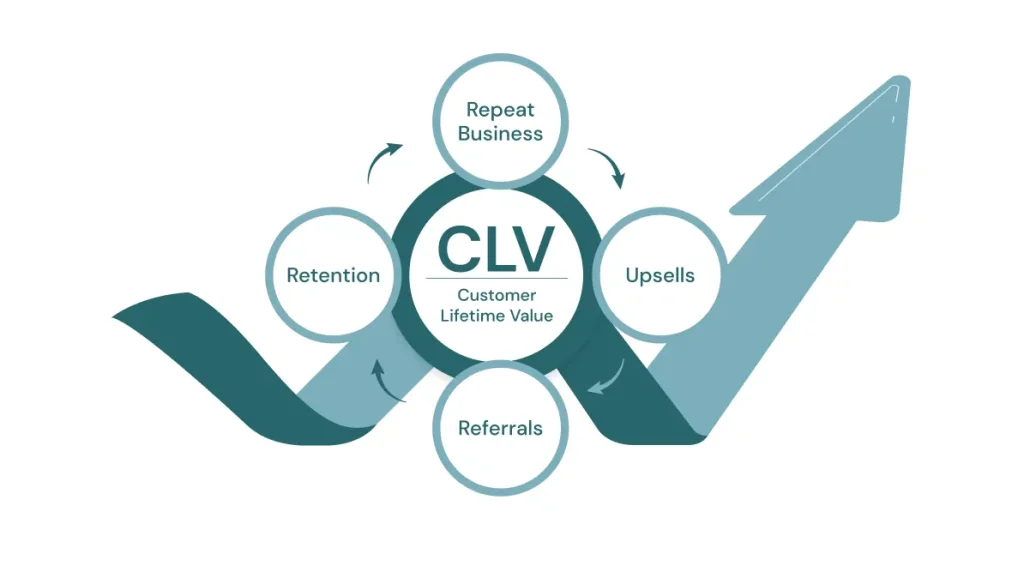
Hard sales techniques and aggressive outbound tactics no longer suffice and are being replaced by, or supplemented by, strategic content creation that generates interest, builds authority and establishes a connection. Competitive advantages are not based on price competition or nicely-packaged promises but on proven expertise and organizational added value. The relationship that is built is not purely transactional but is based on providing value and mutual loyalty and trust. Such a long-term relationship multiplies the CLV and creates a loyal brand ambassador with all its benefits.
Why full-funnel marketing?
1. Invest in both brand building and performance marketing
A sound strategy consists of brand building and performance elements, and research shows that the results of a hybrid campaign with both elements has a better ROI in the long run than performance marketing alone(McKinsey).
However, if a separate brand building and performance campaign are run, the ROI of the brand building campaign is not measurable. CMOs are then more likely to shift budgets to channels that deliver direct conversion. A holistic strategy, or full-funnel strategy, in which both components come together gives a better picture. Metrics such as sales pipeline velocity can demonstrate how brand building influences the buying process.
2. Sustainable growth instead of depleting the target population
Marketers are judged on revenue, mainly short-term revenue. Aggressive outbound campaigns can be effective at the beginning to convert some targets from the BoFu but with this approach you exhaust your target audience tremendously quickly. Especially if you are dealing with a small audience.
After you have converted all the “low-hanging fruit” and you continue to target the same audience, ad costs become higher and effectiveness decreases. A sustainable full-funnel strategy that considers the entire buyer’s journey helps to become top-of-mind so that targets come to you as soon as they are “ready to buy.
3. Focus on ACV and CLV rather than short-term sales
The cheapest and most efficient way to get more sales is through your existing customers. A full-funnel marketing strategy begins well before a target is ready to buy and continues beyond the initial purchase. Invest not only in awareness and conversion but also in customer satisfaction and loyalty. This goes beyond the marketing department but marketing is an extremely appropriate tool for this purpose.
Content strategy for full-funnel marketing
Content is the binder of any successful full-funnel strategy. Not only traditional, static content types such as website blogs, industry reports and white papers but also, for example, video case studies, interactive quizzes or mini-applications, webinars and downloadable templates can be used. Each stage of the buyer’s journey requires appropriate content.

GUIDE
Full-funnel B2B content strategy in 2024
The B2B marketing industry is evolving faster than ever. Because the market is flooded with content …
Key challenges in full-funnel marketing
1. Measuring results
A strategy with more touch points also means better tracking with more complex attribution models. One of the main challenges with a full-funnel strategy is measuring the buyer’s journey. The principle of “dark Social” has a major impact on companies’ abilities to measure cross-channel interaction, including in B2B marketing(RefineLabs).
2. Collaboration
We are all familiar with the importance of marketing and sales alignment and good cooperation between the two departments. Often this alone is not enough. Poor cooperation is one of the causes of an unsuccessful campaghne. A full-funnel strategy required:
- Collaborate with an outside agency or outside specialists; small in-house marketing teams usually do not have all the necessary specialist knowledge in-house.
- Collaboration with communications; internal and external communications must be aligned.
- Close collaboration with senior management; strategy must be seamlessly aligned with the overarching corporate strategy.
- Collaborations with the product team; for content creation and other communications, input from subject matter experts (SMEs) is essential.

3. KPIs
A full-funnel strategy requires using the right KPIs, at the channel level but also overall at the campaign level. Simple engagement metrics like CTR and CPC don’t suffice, but just betting on revenue metrics doesn’t cover it either. Also use metrics such as pipeline coverage ratio, pipeline velocity, churn rates and lifetime value. Appropriate KPIs should be sought for each (sub)objective. Just as pipeline velocity can be used to measure how marketing impacts the length of the sales cycle.
4. Personalization
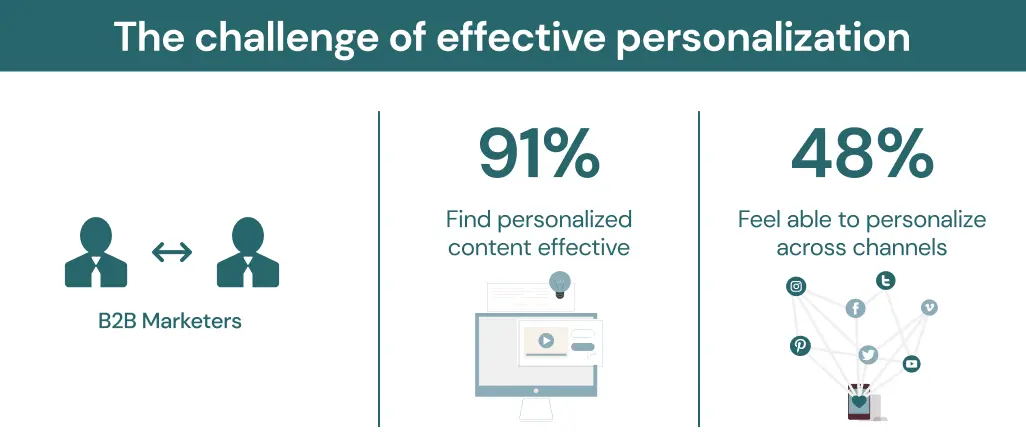
There is no one-size-fits-all full-funnel solution. Personalization is essential in choosing the channels and messages to use. It is important to know exactly who your ideal customer is, what his/her problems are, where you can reach him/her and what their buying criteria are.
When to choose full-funnel marketing?
Full-funnel marketing is not the way to go for every business. Does your business meet (most of) the following characteristics? Then full-funnel marketing is worth considering:
- High-ticket B2B organizations: your company offers high-ticket (CLV over €30K) products or services and faces long buyer’s journeys with many touchpoints, often spread across many different channels.
- Long sales cycles: you deal with long sales cycles, often accompanied by a large buying committee. A good full-funnel strategy does not stop at lead generation but continues to an actual deal, and even beyond.
- Marketing maturity: your organization has some marketing maturity and has the knowledge and resources to formulate and set up a complex full-funnel strategy.
- Long-term focus: you are not only focused on short-term conversion but also willing to invest in reaching the target audience that is not currently ready to buy.
How to implement a full-funnel marketing strategy
Research and planning are key to implementing a full-funnel strategy. Broadly speaking, you can follow the following six steps:
- Set objectives; figure out the objectives. Don’t commit to superficial goals like ‘more leads’ or ‘more website visitors’ but identify your end goal (at the campaign level). For example, aim for “X SQAs per month” or “X% renewal rate for existing customers.” The ultimate goal is probably more revenue but select goals that are appropriate at the campaign level. Revenue depends on much more than just this campaign.
- Identify and research your ICP; determine your ICP and different buyer personas that align with d objectives stated above. Make sure you know everything about who your ideal client is, what he/she is up against and what he/she is looking for in a solution. Interview existing customers to get this clear.
- Map the buyer’s journey; the next step is to map which platforms your targets are on at each stage of the buyer’s journey. Where do they look for information and through which platforms can you approach them at the right time. The buyer’s journey is different for every target, but you can look for similarities and use them as a starting point. Choose which channels become part of your strategy.
- Create the required content; based on your target audience and the channels that will be deployed, a content strategy is formulated, tailored to the buyer’s journey and the different stages the target goes through. Use long-form content such as white papers and industry reports as well as interactive content such as videos and downloadable templates. Check out our guide on full-funnel content creation for more info.
- Set KPIs and install measurement tools; select KPIs that align with your campaign objectives. Determine how to best measure them and link the necessary analytics technology to the channels to be used. Think about an attribution model to use.
- Launch, analyze and adjust; launch your campaign and start measuring results. Continuously modify your targeting, messaging and content based on the insights gathered.
GUIDE
Full-funnel B2B content strategy in 2024
The B2B marketing industry is evolving faster than ever. Because the market is flooded with content …
Conclusion
Full-funnel marketing is not a one-size-fits-all strategy but a starting point for strategy formulation. This guide goes into helicopter-view of what full-funnel marketing is, when to use it and when not to use it. Check out our other resources to learn more about exactly how such a strategy comes about in practice and what it takes to be successful in it. Contact us for a no-obligation session about your marketing session and the issues you’re facing.


